WP Engine Alternatives (2026): Managed Hosts Priced at Your Traffic
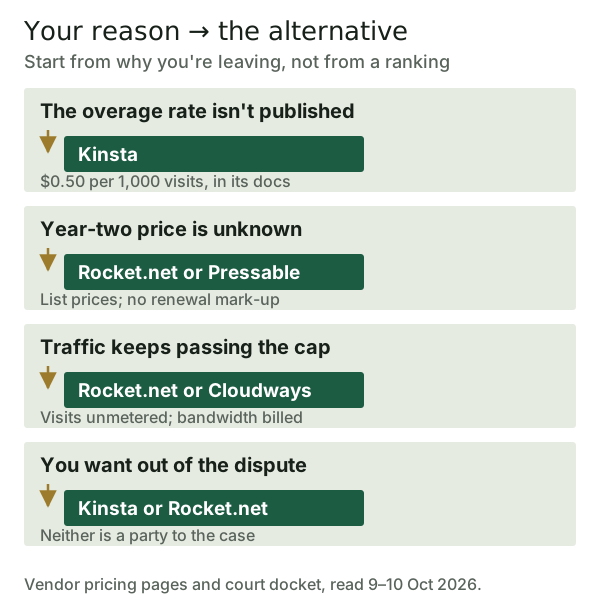
The best WP Engine alternative depends on why you're leaving. If it's the unpublished overage rate, Kinsta publishes $0.50 per 1,000 extra visits at the same $35 entry price. If it's a first-year discount that renews at an unknown rate, Pressable and Rocket.net sell list prices with no renewal mark-up. If your traffic keeps outgrowing visit caps, Rocket.net and Cloudways don't meter visits at all; they bill bandwidth instead.
This page prices each alternative at the traffic you have, not at its entry plan, and flags the one popular "alternative" that is owned by WP Engine. If you're happy on WP Engine and your bill is predictable, there is no reason to move. Every price was read from the vendors' US pricing pages on 10 October 2026, and we have not run speed tests on any of them.
Why people leave, and which reason is yours
Most moves away from WP Engine trace back to one of four things. The first is overage: WP Engine bills overages in arrears each month under its terms of service, yet leaves the per-visit price off its plans page. The second is renewal: its annual prices include a promotional discount for new customers on the Essential plan, and the page says renewal pricing is subject to change.
The third is the shape of the plan ladder. WP Engine's one-site plan covers 25,000 visits; the next published tier is three sites and 75,000 visits at $65 a month, then ten sites and 100,000 visits at $130. A single site that grows past 25,000 visits either pays an unpublished overage or buys installs it doesn't need. The fourth is the legal dispute between WP Engine and Automattic, which a 24 September 2026 ruling narrowed but did not end. Work out which of these is yours before comparing hosts.
The alternatives at a glance
| Host and plan | Monthly | Yearly | Visits / mo | Beyond the plan | Renewal | Migrations |
|---|---|---|---|---|---|---|
| WP Engine Essential, 1 site | $35 | $336 (first year) | 25,000 | Overage rate not published | Not published | Free automated plugin |
| Kinsta Single 35k | $35 | $350 | 35,000 | $0.50 per 1,000 visits | List price | Unlimited, free |
| Pressable Signature 1 | $25 | $250 | 30,000 | $1.20 per 1,000 visits | List price | Free, any number |
| Rocket.net Starter | $30 | $300 | Unmetered (50 GB bandwidth) | $0.08/GB bandwidth | No renewal increases, per Rocket.net | Unlimited, free |
| Cloudways Autonomous Growth | $99 | Not shown | Unmetered (150 GB bandwidth) | $0.04/GB bandwidth (pricing page; a Cloudways blog differs, so check) | Not stated | Check at signup |
| Flywheel Starter (WP Engine-owned) | Not shown | $300 | 25,000 | $1 per 1,000 visits | Not published | Not confirmed; ask before buying |
The column that separates these hosts is "beyond the plan". Kinsta, Pressable and Flywheel cap visits and publish what an extra thousand costs. Rocket.net and Cloudways don't count visits; they cap bandwidth and charge per gigabyte past it. WP Engine caps visits and doesn't publish the rate, which is why its column is the hardest to budget against.
Visit caps are not interchangeable between hosts, because each counts a visit its own way. Kinsta, for example, counts unique IP addresses per 24 hours, while WP Engine calls its visit numbers estimates. Our explainer on managed WordPress pricing models covers why per-visit and per-bandwidth plans behave so differently as a site grows.
What each costs at 25,000 and 100,000 visits
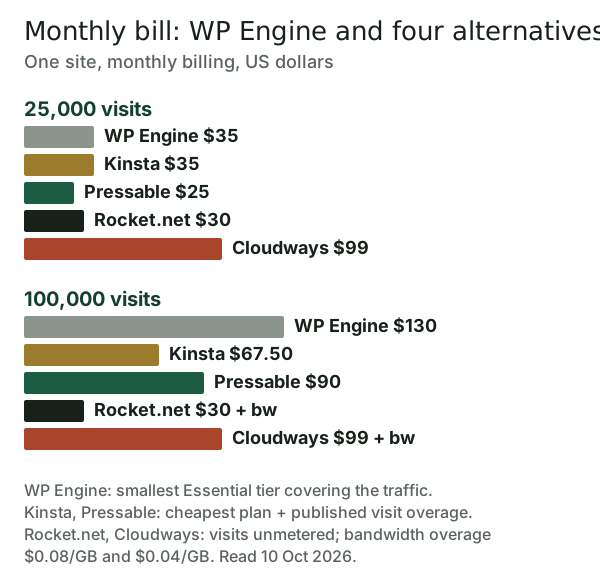
At 25,000 visits every option except Cloudways Autonomous sits between $25 and $35 a month, so price alone is a weak reason to switch at that size. At 100,000 visits the spread opens up: WP Engine's smallest covering plan is $130, Pressable's cheapest route is $90, and Kinsta's is $67.50, staying on Single 35k or Single 65k and paying its published overage.
Rocket.net's Starter plan stays at $30 because it doesn't meter visits, but it includes 50 GB of bandwidth, so a busy site pays $0.08 for each extra gigabyte or moves to Pro at $60 with 100 GB. If each of 100,000 visits loads one page at the HTTP Archive's 2025 median for a mobile inner page, about 1.8 MB, that is roughly 180 GB of transfer; how much of that Rocket.net counts against the allowance once its CDN caches pages is something to confirm with its sales team.
The alternatives, one by one
Kinsta: the same entry price with a published overage
Kinsta's Single 35k plan costs $35 a month or $350 a year for one site and 35,000 visits, and its overage is $0.50 per 1,000 visits, so a traffic spike becomes arithmetic rather than a surprise. Its annual price is ten times the monthly one with no separate introductory rate, its SLA defaults to 99.9% uptime with service credits, and migrations are unlimited and free. A first WordPress plan with Kinsta starts with a free month on its entry tiers. It suits a single business site leaving WP Engine because of overage uncertainty. Our Kinsta vs WP Engine comparison has the plan-by-plan detail.
Affiliate link, marked sponsored/nofollow. We may earn a commission at no cost to you — it never changes a score or a ranking.
Pressable: list prices and generous installs
Pressable's ladder begins with Signature 1, one install and 30,000 visits for $25 monthly, and climbs to Signature 4: ten installs and 150,000 visits for $90. Its pricing page shows no separate renewal rate, it includes Jetpack Security, and its team migrates any number of sites free. The trade-off is a $1.20 overage per 1,000 visits, so pick a tier that covers your busiest month. Some buyers also weigh that Pressable is an Automattic hosting lab and Automattic is WP Engine's opponent in court; that cuts both ways.
Affiliate link, marked sponsored/nofollow. We may earn a commission at no cost to you — it never changes a score or a ranking.
Rocket.net: unmetered visits and no renewal increases
Rocket.net's Starter plan costs $30 a month, or $25 a month billed yearly, for one install, 10 GB of storage and 50 GB of bandwidth, with visitors unmetered. It charges $1 for the first month, offers a 30-day money-back guarantee outside its Enterprise plans, and states that it will never raise prices on renewal. Its homepage lists free SSL, a CDN and a web application firewall, describes the CDN as enterprise-grade, and offers unlimited free migrations carried out by its own team. It suits sites leaving WP Engine because visit caps keep tripping.
Affiliate link, marked sponsored/nofollow. We may earn a commission at no cost to you — it never changes a score or a ranking.
Cloudways: managed cloud servers instead of plans
Cloudways, owned by DigitalOcean since 2022, sells managed WordPress on cloud servers rather than visit-capped plans. Flexible servers are summarised as from $11 a month, but the smallest DigitalOcean server on the US pricing page, with 1 GB of memory, lists at $14 a month. Autonomous, its single-site line, begins with Growth at $99 a month, with visits unmetered, 150 GB of bandwidth and 20 GB of disk, autoscaling beyond a baseline for an hourly fee; that structure has applied to new customers since 12 November 2025, and the pricing page lists extra disk at $1 per GB, though a Cloudways blog post gives different overage rates, so confirm them before you sign up. Cloudways offers a three-day free trial without a card, and suits technically comfortable owners who would rather size a server than a visit tier.
Affiliate link, marked sponsored/nofollow. We may earn a commission at no cost to you — it never changes a score or a ranking.
What you give up by leaving
WP Engine is not a bad host, and a fair comparison counts what it does well. It keeps backups for 30 to 60 days, against 14 days on Kinsta's entry plans. Its bundled extras, ten premium themes and Genesis Blocks, come with every tier from Essential up, and adding a site costs $20 a month where Kinsta charges $30. For several small sites, its three-site plan at $65 and ten-site plan at $130 are hard to beat on a per-site basis.
Its global CDN is powered by Cloudflare, like Kinsta's network edge, so moving for speed alone is a weak reason without testing your own site. And WP Engine's Core and Enterprise tiers carry a 99.99% uptime SLA, although neither has a public price. If your bill is stable, your traffic sits inside its tier and the renewal quote you receive is acceptable, staying put costs nothing in migration effort.
Migration effort per alternative
Leaving WP Engine is a standard WordPress move: files, database and DNS. What differs is who does the work. Kinsta and Rocket.net advertise unlimited free migrations, and Rocket.net says its team takes care of the move, which typically takes under an hour. Pressable will migrate any number of sites for free or let you use its automated plugin; you check the result and switch DNS yourself. Cloudways' current migration terms weren't on the pages we read, so confirm them before you sign up.
Two WP Engine-specific steps are easy to miss. Its contracts auto-renew, and notice of non-renewal is due 30 days before the term ends, so time your move against that date rather than the renewal invoice. And if your site uses themes or blocks that came bundled with WP Engine, such as Genesis Blocks, check how they are licensed outside WP Engine before you move. Our step-by-step guide to migrating to managed WordPress covers testing on the new host before you change DNS.
The sister brand that isn't an alternative
Flywheel appears on many lists of WP Engine alternatives, but WP Engine has owned it since 2019 and its site footer carries WP Engine's name. Its Starter plan costs $300 a year for one site and 25,000 visits, with an overage of $1 per 1,000 visits and a 60-day money-back guarantee on new plans other than Agency and Custom. It is a fine host with a designer-friendly workflow, but if your reason for leaving is WP Engine itself, its pricing policy or its lawsuit, moving to Flywheel changes the dashboard, not the company.
Edge cases
- Mid-contract on annual billing. A prepaid year doesn't refund on a move; run both hosts in parallel for the last weeks rather than paying a second year.
- Several client sites. WP Engine's three- and ten-site tiers are good value for small sites; Pressable's Signature 3 and 4 are the closest like-for-like, with more installs per dollar.
- Apps beyond WordPress. Kinsta also sells application and database hosting under its Sevalla brand, and Cloudways launched managed Node.js hosting in September 2026, which matters if your stack includes other services.
- Burst-heavy stores. A visit-capped host bills every bot and every flash-sale visitor; an unmetered host shifts the risk to bandwidth, which a CDN can absorb.
If your situation is one of those, test the new host with a copy of your real site during its trial or refund window before you commit for a year. For the full field ranked side by side, see our list of the best managed WordPress hosting.
WP Engine alternatives: quick answers
What is the best alternative to WP Engine?
Is Flywheel a WP Engine alternative?
Which WP Engine competitor is cheapest?
Is it hard to migrate away from WP Engine?
Did the WP Engine lawsuit end?
See how this fits the field: the best managed WordPress hosting, ranked, or read whether managed WordPress hosting is worth it.